


Store-bought drain cleaners work by dissolving whatever’s clogging the pipe with a strong acid or base — and that same reaction can eat away at older metal pipes, damage PVC over repeated use, and isn’t something you want splashing back at you if the clog doesn’t clear on the first try. The good news is that most household clogs (hair, soap scum, grease, food debris) respond just as well to mechanical methods that cost nothing and carry zero risk to your plumbing.
Here are six chemical-free ways to unclog a drain, roughly in order of “try this first” — starting with what’s already under your sink and working up to the tools worth buying if the easy stuff doesn’t do it.
⚠️ Important Information Before You Buy
Affiliate Disclosure
This post contains affiliate links to Amazon. When you purchase through these links, we may earn a small commission at no additional cost to you. This helps support our research and allows us to continue providing free, comprehensive guides like this one. We only recommend products we genuinely believe in and have thoroughly researched.
Price Accuracy Note
Prices listed are approximate and based on recent Amazon pricing. Amazon prices change frequently, and current prices may differ from those shown. Always check the current price and read recent reviews before making your purchase.
1. Boiling Water
The simplest option and worth trying first on any slow drain, especially in a kitchen sink where the culprit is usually grease or soap buildup that boiling water can soften and flush loose. Boil a full kettle, then pour it down the drain in two or three stages, giving it 20-30 seconds between pours to work through the clog rather than just running over the top of it.
Best for: Grease and soap-scum clogs. Skip this one if: You have PVC pipes with older solvent-welded joints, or the drain is fully backed up with standing water — boiling water just sits on top of standing water and won’t reach the clog.
2. Baking Soda and Vinegar
This isn’t quite the powerful reaction the internet makes it out to be — the fizzing is mostly for show — but the combination does help loosen light buildup, and it’s genuinely useful for cutting odor in a slow drain even when it’s not the thing that fully clears it.
How to do it: Pour about half a cup of baking soda down the drain, followed by half a cup of white vinegar. Cover the drain (a wet cloth works) to keep the fizzing reaction directed down into the pipe instead of just bubbling back up, let it sit for 15-30 minutes, then flush with hot water.
Curious how far vinegar can go on a tougher clog? We tested it separately — see will vinegar unclog a washing machine drain for that verdict.
3. A Plunger (Yes, for Sinks Too)
A standard cup plunger — the kind everyone already owns for the toilet — works on sink and tub drains as well, and it’s often strong enough to dislodge a clog that’s just past reach of your fingers.
How to do it: Add a couple inches of water to the sink or tub so the plunger has something to seal against, block any overflow opening with a wet rag (double-sink setups also need the second drain plugged), and plunge with firm, steady strokes for 15-20 seconds. You should feel resistance build and then release as the clog breaks up.
4. A Drain Snake or Zip-It Tool
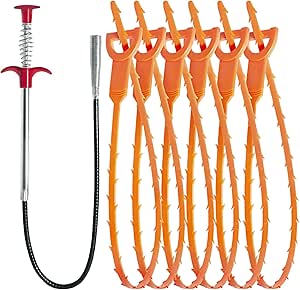
If the first three haven’t worked, the clog is probably physical — hair, soap residue, or food debris sitting a few inches down — and no amount of hot water or fizzing is going to move it. This is where a flexible drain-snake tool earns its keep: it’s a barbed or ridged plastic strip you feed down the drain to physically hook the clog and pull it back out, and it’s genuinely the most effective non-chemical fix for the hair clogs that cause the majority of bathroom sink and tub slowdowns.
How to do it: Feed the tool down the drain past the stopper, twist and push until you feel resistance, then pull it back out slowly — expect it to come back genuinely unpleasant, which is exactly the point. Repeat two or three times until it comes back clean. A set like the Hair Drain Clog Remover Tool – 7-Piece Sink Snake Set gives you multiple lengths and barb styles for sinks, tubs, and showers, and it’s cheap enough to keep one under every sink in the house.
5. A Wet/Dry Shop Vacuum
An underused option for a genuinely stubborn clog: a wet/dry shop vac can pull a blockage out the way it went in, using suction instead of a chemical reaction or a plunger’s push.
How to do it: Set the vacuum to liquid mode if it has one, create as tight a seal as you can over the drain opening (an old plunger head works well for this), and run the vacuum for a minute or two. Have a bucket ready — this is a messy method, but effective on clogs that are just beyond the reach of a snake tool.
6. Clean Out the P-Trap
If nothing above has worked, the clog is most likely sitting in the P-trap — the curved section of pipe under the sink that holds a small amount of water to block sewer gas. It’s the most involved option on this list, but it’s also close to guaranteed to work, since you’re removing the clog directly rather than trying to flush or hook it from above.
How to do it: Put a bucket under the trap, loosen the slip nuts on both ends by hand or with pliers, and slide the trap off. Empty it into the bucket, clear any debris with an old toothbrush, check that the trap’s rubber washers aren’t cracked, and reassemble hand-tight plus a quarter turn with pliers. Run water to check for leaks before you consider it done.
One more thing worth knowing about the P-trap: it also blocks sewer gas from coming up through the drain, so a trap that sits dry too long (an unused guest bathroom, a vacation home) can cause a bad smell even with no clog at all — see sewer smell in a house at night if that’s closer to your actual problem.
A Quick Way to Choose Where to Start
- Kitchen sink draining slowly, likely grease? Start with boiling water.
- Bathroom sink or tub draining slowly, likely hair? Skip straight to the drain snake — it’s the most effective tool for this specific clog.
- Fully backed up, standing water? Plunger first, then the snake.
- Still clogged after all of that? The P-trap is almost certainly holding the blockage.
If your clog is on a line shared with a washing machine rather than a standalone sink or tub drain, the setup is a little different — see can a washer and sink share a drain for that case specifically.
None of these methods risk damaging your pipes the way repeated chemical drain cleaner use can, and most clogs clear with the first two or three steps on this list. Keep a drain snake tool under each sink and you’ll rarely need to go further than that.